
Sarcoma Awareness Month: Why Comparative Oncology Matters
July is Sarcoma Awareness Month in the UK, one we take seriously at ValiRx and ValiRx Animal Health.
Sarcoma is a rare cancer of the body's connective tissue; bone, muscle, fat, blood vessels, tendons, cartilage. It can arise almost anywhere, across dozens of subtypes that behave very differently. That diversity is exactly what makes it so hard to diagnose and treat.
16 people are diagnosed every day in the UK¹ - around 5,900 a year¹. Split by type, approximately 700 people in the UK are diagnosed with bone sarcoma each year (around 2 per day) and 5,200 with soft tissue sarcoma each year (around 14 per day)¹.
This year, we want to shine a light on one subtype in particular: osteosarcoma.
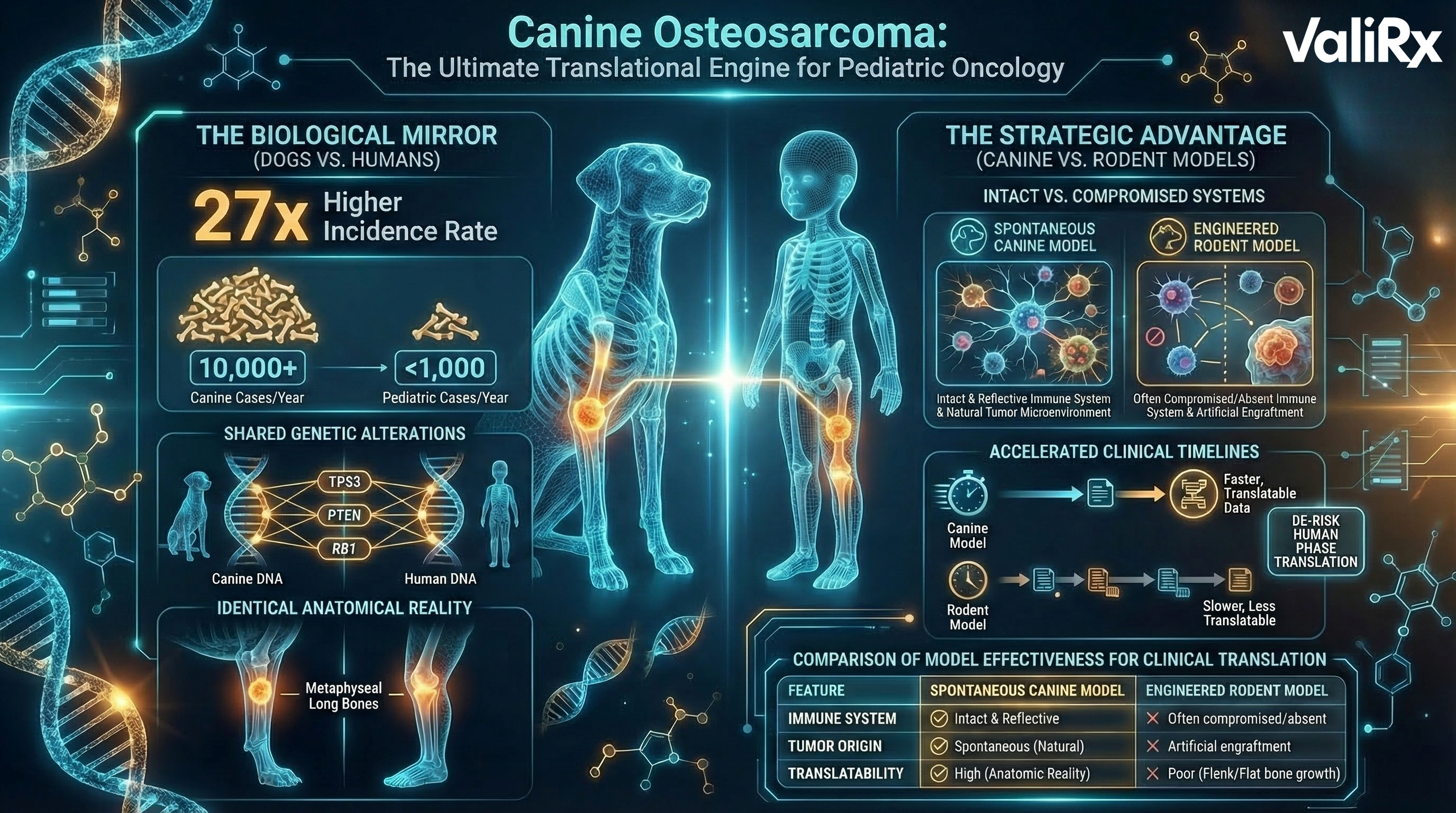
Osteosarcoma is the most common primary bone cancer, and unlike most sarcomas - which mainly affect older adults - it has a very different age profile. It typically arises in the metaphyseal region of long bones, the area of rapid growth during puberty⁵, making it the most common bone cancer in children and young people², peaking in patients aged 15–19³.
Bone sarcoma overall has a ten-year survival of just over 55%², though for osteosarcoma specifically, outcomes vary sharply by stage - metastatic disease in young patients carries a far lower five-year survival, at just 20–30%⁴. Treatment options haven't moved much in decades, survival has plateaued since modern chemotherapy, but recent efforts are focused on targeted and immune-based therapies, despite the heterogeneity of the disease⁵.
That's where comparative oncology comes in.
Osteosarcoma is also one of the most common cancers in dogs, especially large and giant breeds⁶,⁷, sharing striking biological and clinical similarities with the human disease, same genetic drivers, same metastatic pattern⁸. Naturally occurring disease in companion animals gives researchers a faster, more translatable model than induced tumours, and the dogs enrolled benefit directly.
That's the bridge ValiRx Animal Health is built to cross. Inaphaea Biolabs holds a biobank of 31 sarcoma patient-derived cell models spanning bone and soft tissue origin, allowing us to study tumour biology across subtypes and species in parallel, rather than as separate tracks.
The goal: use naturally occurring disease in animals to accelerate treatments for people, including the young patients who need them most, while improving outcomes for animals too.
Sarcoma doesn't get the visibility of more common cancers, and visibility drives funding, diagnosis speed and research investment. If you work in oncology, veterinary medicine or drug development and want to talk comparative oncology, we'd love to hear from you.
References:
¹ Sarcoma UK: https://sarcoma.org.uk/about-us/stay-connected/sarcoma-incidence-and-survival-statistics-in-the-uk/
² Cancer Research UK: https://www.cancerresearchuk.org/health-professional/cancer-statistics/statistics-by-cancer-type/bone-sarcoma
³ https://www.bcrt.org.uk/information/information-by-type/osteosarcoma;
⁴ Children with Cancer UK — https://www.childrenwithcancer.org.uk/cancer-types/sarcoma/bone-sarcoma/osteosarcoma/
⁵ Morya VK, Magar AG, Park SH, Noh KC. Systemic strategies for osteosarcoma: advances and future directions. Discov Oncol. 2025;16(1):1367. Published 2025 Jul 18. doi:10.1007/s12672-025-02208-9
⁷ https://www.akcchf.org/disease-history/bone-cancer-in-dogs/
⁸ https://www.biorxiv.org/content/10.1101/2023.09.27.559797.full.pdf
Share your feedback
Discover